Tampilkan postingan dengan label race consciousness. Tampilkan semua postingan

Kamis, 12 November 2015

Last night in Yale's Battell Chapel, crowds crammed "A Moment of Crisis: Race at Yale Teach-In."

Do you think of Yale as a religious institution? Up until 1926, Yale students were required to attend services at Battell Chapel:


Inside are stained glass windows depicting such characters as George Berkeley and Jonathan Edwards. It's quite a venue.

Here's the the Yale Daily News report on last night's teach-in. Excerpt:
The forum... opened with two spoken word poems performed by black female students. The first highlighted the lack of support that black men offer their female counterparts. Both poems brought audience members to their feet in a standing ovation. 
I'd like to see video of that. Strange to begin with what sounds like an attack on black men. A real crowd-pleaser, we're told.
“I want to make sure that I’m moving towards the informed camp and moving myself away from the ignorant camp,” Molly Zeff ’07 SOM ’16 said. “This is a fight that’s only going to be possible if the people who most benefit from systemic racism, which include myself, are fully aware of the people who most suffer from systemic racism.”

Mojique Tyler ’19 expressed similar sentiments, adding that he could not sit idly by while his community is experiencing problems and challenges.... Describing himself as a black, atheist, agender and Jewish individual with one parent who is white, Tyler... said the struggle of identity that the forum touched upon was relevant to his own experiences....

Rabu, 04 November 2015

"Racism? By whom? This video of Texas cops stopping a black professor is a racial 'Rorschach test.'"

University of North Texas professor Dorothy Bland: "Walking while black is a crime in many jurisdictions... May God have mercy on our nation."

Police chief: "If we didn’t have the video, these officers would have serious allegations against them... Every white officer that stops an African American does not constitute racial profiling."

Rabu, 28 Oktober 2015

"Now, what could possibly be wrong with the description 'hard worker'?"

Asks Greta Van Susteren before playing video of Melissa Harris-Perry calling out a guest for saying that Paul Ryan is a "hard worker."

This is Harris-Perry's stern warning:  "I want us to be super-careful when we use the language 'hard worker,' because I actually keep an image of folks working in cotton fields on my office wall, because it is a reminder about what hard work looks like."

Oh, so the slave is the idealized "hard worker"? Then why, just a couple weeks ago did a textbook publisher, McGraw-Hill, have to apologize and agree to change a geography textbook that referred to slaves as "workers"?
On reading a caption in his geography textbook that described slaves as “workers”, Coby Burren sent a photo and an annoyed message to his mother. "We was real hard workers wasn’t we," he wrote.

Roni Dean-Burren was also disturbed by the language, and posted about the book online. Her comments went viral and the publisher swiftly decided to rewrite the section....
"We are deeply sorry,"  said the publisher's chief executive for a map of "Patterns of Immigration" that had a notation: "The Atlantic Slave Trade between the 1500s and 1800s brought millions of workers from Africa to the southern United States to work on agricultural plantations."

Even assuming you want to follow the instruction to "be super-careful," it's hard — if I may use the word — to figure out which way to go.

The McGraw-Hill incident teaches that you should never refer to slavery without framing it in somber moral terms. It can't be mixed in with other matters as if it were not a unique evil.

The "Paul Ryan is a 'hard worker'" incident teaches that slavery must be mixed into discussions of, well, perhaps anything. If someone complains about the heat, maybe you should get on their case for not acknowledging how much more slaves suffered from the heat. If somebody comments that the food isn't very good, you should lay into them about how poorly fed the slaves were? (That sounds like the opposite of "super-careful.")

Kamis, 15 Oktober 2015

The "Very Black" project.

What does it mean? That's the point.
"We ask people how they experience the statement. The T-shirt. Us. Their experiences. Their non-experiences. That's if they care, comment or inquire. It's really engaging and no pressure," [ artist-educator André D.] Singleton said.

For both men, there's no single definition for the phrase "Very Black."

"It is for sure empowering, relatable, vast, inclusive and real," Singleton said. "It means a lot of things to a lot of people. We are learning as we go just as we have our entire lives."

Selasa, 13 Oktober 2015

"I live knowing that whatever my blackness means to me can be at odds with what it means to certain white observers, at any moment."

"So I live with two identities: mine and others’ perceptions of it. So much of blackness evolving has been limited to whiteness allowing it to evolve, without white people accepting that they are in the position of granting permission. Allowing. If that symbiotic dynamic is going to change, white people will need to become more conscious that they, too, can be perceived."

So writes Wesley Morris in a long New York Times Magazine article "The Year We ObsessedOver Identity" with the long subtle: "2015's headlines and cultural events have confronted us with the malleability of racial, gender, sexual and reputational lines. Who do we think we are?" The article has some topics that I've covered on this blog over the year — Rachel Dolezal, Atticus Finch — but the reason I wanted to blog this is that it ends talking about a book that I happened to notice for the first time yesterday, "Far From the Tree," by Andrew Solomon. Here's how Wesley Morris uses that book:
It could be that... it’s... in our natures to keep trying to change, to discover ourselves. In ‘‘Far From the Tree,’’ Andrew Solomon’s landmark 2012 book about parenting and how children differentiate themselves, he makes a distinction between vertical and horizontal identity. The former is defined by traits you share with your parents, through genes and norms; the latter is defined by traits and values you don’t share with them, sometimes because of genetic mutation, sometimes through the choice of a different social world. The emotional tension in the book’s scores of stories arises from the absence of love for or empathy toward someone with a pronounced or extreme horizontal identity — homosexuality or autism or severe disability. Solomon is writing about the struggle to overcome intolerance and estrangement, and to better understand disgust; about our comfort with fixed, established identity and our distress over its unfixed or unstable counterpart.

Sabtu, 03 Oktober 2015

"How many girlfriends have you had?"/"0. Never had anyone."

"Well, it means I’ve never been with anyone, no woman nor man (nor dog or animal or any other).... must be saving himself for someone special... Involuntarily so."
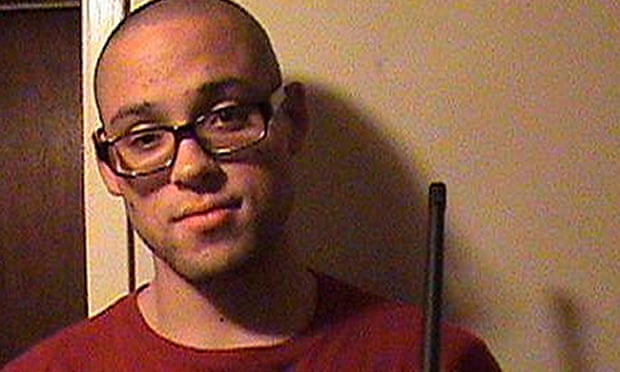
“He did not like his lot in life, and it seemed like nothing was going right for him,” a law enforcement official said, describing the writings found at the crime scene. “It’s clear he was in a very bad state of mind.”...

[H]e lived with his mother, Laurel Harper, a nurse who fiercely protected him from, among other things, the neighborhood sounds of loud children and barking dogs. Once, neighbors said, she went door to door with a petition to get the landlord to exterminate cockroaches in her apartment, saying they bothered her son.
Here are some "new details" about Harper-Mercer, whose relationship with his mother reminds me of Adam Lanza's. That sensitivity to sound is suggestive of an autistic disorder, and Harper-Mercer attended The Switzer Learning Center, which deals with "learning disabilities, health problems and autism or Asperger's Disorder."
Sofia Camarena of Long Beach, California, told The Oregonian/OregonLive that she used to date Harper-Mercer's father. "I used to change Chris' diapers when he was a baby," she said.... "He was born with problems. He was hard to discipline. If you told him 'no,' he would scream like you had just hit him."...

There are a number of indications that Harper-Mercer had mental health or behavioral issues. His screen name on some social media sites was "lithium love." Lithium is used as a psychiatric medication.
"Lithium" is also a song title. Lyrics: "I'm so lonely but that's okay I shaved my head..."


"... and I'm not sad/And just maybe I'm to blame for all I've heard/But I'm not sure..."

Harper-Mercer was discharged from the Army 5 weeks into basic training for failing to meet "minimum administrative standards."
Harper-Mercer was born in the United Kingdom, stepsister Carmen Nesnick told CBS Los Angeles, moving to the United States when he was very young. He grew up in the Torrance area. His parents, Ian Bernard Mercer and Laurel Margaret Harper, divorced in 2006.
Note the erasure of the racial element. As The Daily Beast reported: Harper's father is white and his mother black.