Tampilkan postingan dengan label writing. Tampilkan semua postingan

Selasa, 10 November 2015

Hey, The Chronicle of Higher Education used my photo of Camille Paglia for its interview.

Here. I put a Creative Commons license on it, and they gave me credit, so it's perfectly legit. Here's the old blog post from 2005, with numerous photos, covering an appearance by Paglia in a local Borders Bookstore: "Try to survive a tornado with a post-structuralist."

As for the interview, Camille says, when asked "How did you learn to write?":
Like a medieval monk, I laboriously copied out passages that I admired from books and articles — I filled notebooks like that in college. And I made word lists to study later. Old-style bound dictionaries contained intricate etymologies that proved crucial to my mastery of English, one of the world’s richest languages.

Rabu, 04 November 2015

"Ariana Grande Is Not Here for Your Sexist Interview Questions."

I'm only posting about this because I already have an Ariana Grande tag. That tag only has one other post and it's a post that contains the phrase "I'm only posting because...."

The other post is "Thanks for licking the doughnut, Ariana Grande." She's the celebrity who licked a doughnut that was on a tray left unsupervised in a doughnut shop where anyone could just come up and lick it.

I appreciated her calling our attention to unattended doughnuts, and now she's applying her celebrity power to the problem of radio show hosts asking female celebrities questions like "If you had to choose between your phone and makeup, which would you give up?"

As for the doughnuts tag, which this post also gets, it's not languishing so unused I wish I'd never created it. It's rolling along. This is its 33rd appearance.

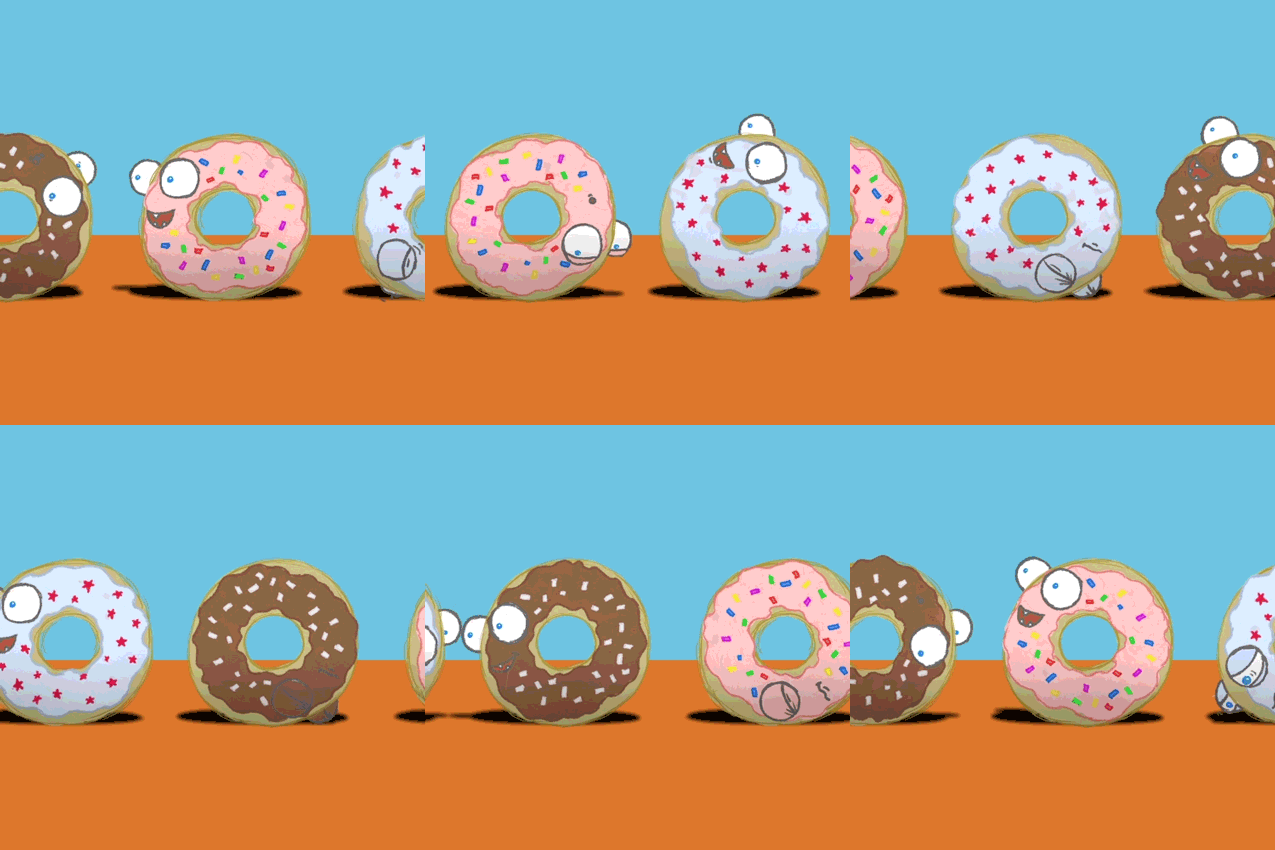
I wanted to illustrate this post with an image of a rolling doughnut. (Yeah, here's a good one.) But searching for "rolling doughnut" turned up "15 Things Kurt Vonnegut Said Better Than Anyone Else Ever Has Or Will," and one of them is: "Why don't you take a flying fuck at a rolling doughnut? Why don't you take a flying fuck at the mooooooooooooon?"

#1 on that list is "I urge you to please notice when you are happy, and exclaim or murmur or think at some point, 'If this isn't nice, I don't know what is.'" I read that out loud to Meade without identifying the context and he thought I was reading something I'd written. His reaction was: "I think it's below your normal writing."

And that's it for the second Ariana Grande blog post.

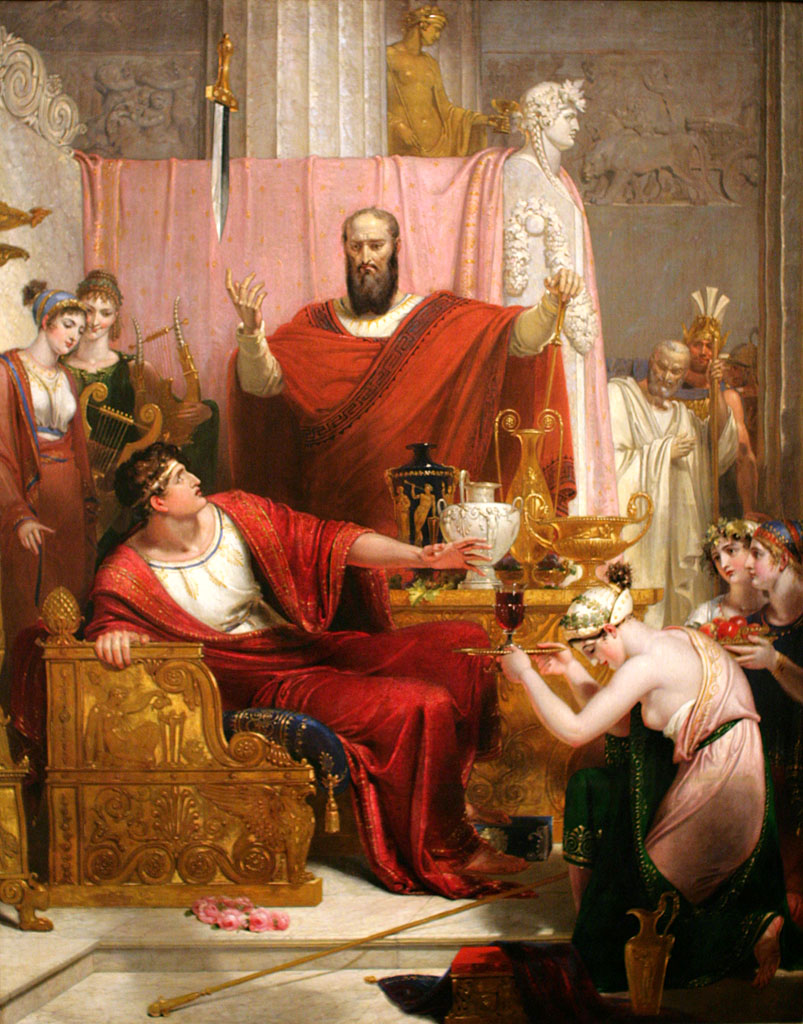
"We hang over each other’s heads, more and more heavily, self-appointed swords of Damocles waiting with baited breath to strike."

I'm trying to read "The Decay of Twitter" — an article in The Atlantic critical of the way people write on Twitter — but what about the way people write in The Atlantic? That sentence, quoted above, may be the worst sentence I've read in the last 10 years.

First, what the hell is "baited breath"? Avoid clichés and you won't have this problem, but FYI, it's "bated breath." No one uses the verb "bate" anymore, but it's like "abate." If you have "bated breath," you're holding your breath. If you have "baited breath," maybe you've been eating fish, but it has little to do with acting like a sword hanging over everyone's head.

But a sword of Damocles can't be waiting and looking for things to strike at. The sword of Damocles hangs over the one person who's sitting under it. (So don't sit there!)


The sword has no mind and makes no decision about when to strike. It hangs by a hair and will, when the hair breaks, fall only on the person who's under it. The sword doesn't become progressively heavier, nor does it "appoint' itself.

You shouldn't be using these clichés in the first place, but using them without thinking about what they mean and what images you're creating is atrocious — especially in an article that purports to critique writing.

Selasa, 03 November 2015

"I’ve also never Googled myself. It wouldn’t occur to me to do so. It’s the same reason I don’t watch pornography."

"It’s not that I occupy some moral high ground. I just think: Down that road lies madness."

Says the memoirist Mary Karr, who also says "Narcissism is the bacterium infecting all bad writing."

It's the way Justice Kennedy expressed his hate for the term "swing vote" that's so revealing.

"I hate that term... I get this visual image of spatial gyrations. The cases swing; I don’t."

The most revealing thing is not that he hates the term "swing vote." That's not surprising. He wants to be thought of as serious and consistent. The term impugns.

The most revealing thing is that in thinking about an abstraction, he gets a visual image and his thinking about an abstraction is, it seems, influenced by the way that abstraction-made-concrete looks in his mind.

This is useful for lawyers who are trying to figure out how to tip Kennedy one way or the other. Did "tip" just give you a visual image? If not, then you don't have the kind of mind that Kennedy seems to have.

Personally, I have this kind of mind, and I know very well how thought is influenced by language that generates images. The word "swing" makes Justice Kennedy picture a swing — picture himself as a swing, suspended, ungrounded, susceptible to pushes — and he hates (strong word!) how he looks in that image. Perhaps he sees himself as a child on a swing. Perhaps he sees himself as the bad guy in a western who's going to swing in a hangman's noose.

Stressing the vividness of the image as it appears in his mind, he indulges — even as he's speaking with notable concision — in a redundancy, adding the unnecessary adjective "visual" to "images."

So it seems that Justice Kennedy is one of these people for whom the metaphors within words feel alive. George Orwell wrote about dying metaphors in "Politics and the English Language":
A newly invented metaphor assists thought by evoking a visual image, while on the other hand a metaphor which is technically "dead" (e.g. iron resolution) has in effect reverted to being an ordinary word and can generally be used without loss of vividness. But in between these two classes there is a huge dump of worn-out metaphors which have lost all evocative power and are merely used because they save people the trouble of inventing phrases for themselves. Examples are: Ring the changes on, take up the cudgel for, toe the line, ride roughshod over, stand shoulder to shoulder with, play into the hands of, no axe to grind, grist to the mill, fishing in troubled waters, on the order of the day, Achilles' heel, swan song, hotbed...
What Orwell didn't say was that the effect of language varies from person to person. There is no objectivity to the perception whether a metaphor is fully alive, totally dead, or somewhere in the gray area between life and death.

The life of a metaphor is a subtle matter that belongs within the realm of the individual mind, including the mind of the man who (co)wrote: "At the heart of liberty is the right to define one’s own concept of existence, of meaning, of the universe, and of the mystery of human life."

Did he get a visual image of a heart, a beating heart of liberty? Did he see, within that heart, the universe? Did the image of the universe inside a heart blur into a mystery as he compared the universe inside a heart with the unborn baby inside a womb — two bodily organs containing — who's to say? — everything?

You may think the life of that baby is undeniably, concretely real, but do you understand how real liberty might look in the mind of a man who gets visual images?

ADDED: The Orwell quote contains the very phrase I marked as a redundancy: "A newly invented metaphor assists thought by evoking a visual image..."

Minggu, 18 Oktober 2015

"Susan Cheever... includes a heart-lacerating quote by her father: 'If you are an artist, self-destruction is quite expected of you.'"

"'The thrill of staring into the abyss is exciting until it becomes, as it did in my case, contemptible.' She notes that 'all five of our twentieth-century literature Nobel laureates were alcoholic — Sinclair Lewis, Eugene O’Neill, William Faulkner, Ernest Hemingway, and John Steinbeck.' (A proud tally.) And those are the ones who made it to the top. Lots of other great writers who didn’t receive the Nobel laurel were just as pie-eyed. Today, the pendulum seems to have swung again. Cheever says that most of our leading literary figures are fairly abstemious. Whether this will make for more interesting biographies remains to be seen."

From Christopher Buckley's review of Susan Cheever's "Drinking in America: Our Secret History."

Sabtu, 17 Oktober 2015

Obama has a long conversation with the novelist Marilynne Robinson, who's got a new book, a set of essays, on topics like fear and politics.

Obama — who professes familiarity with and love for Robinson's novels — calls attention to the essay "Fear," which, as he puts it, looks "through the prism of Christianity and sort of the Protestant traditions that helped shape us." Basically, he's interviewing her. I can't think of a time when I've read a dialogue with a President where the President is the interviewer:
The President: Tell me a little bit about how your interest in Christianity converges with your concerns about democracy.

Robinson: Well, I believe that people are images of God. There’s no alternative that is theologically respectable to treating people in terms of that understanding. What can I say? It seems to me as if democracy is the logical, the inevitable consequence of this kind of religious humanism at its highest level. And it [applies] to everyone. It’s the human image. It’s not any loyalty or tradition or anything else; it’s being human that enlists the respect, the love of God being implied in it.

The President: But you’ve struggled with the fact that here in the United States, sometimes Christian interpretation seems to posit an “us versus them,” and those are sometimes the loudest voices. But sometimes I think you also get frustrated with kind of the wishy-washy, more liberal versions where anything goes.... How do you reconcile the idea of faith being really important to you and you caring a lot about taking faith seriously with the fact that, at least in our democracy and our civic discourse, it seems as if folks who take religion the most seriously sometimes are also those who are suspicious of those not like them?

Robinson: Well, I don’t know how seriously they do take their Christianity, because if you take something seriously, you’re ready to encounter difficulty, run the risk, whatever. I mean, when people are turning in on themselves—and God knows, arming themselves and so on—against the imagined other, they’re not taking their Christianity seriously. I don’t know—I mean, this has happened over and over again in the history of Christianity, there’s no question about that, or other religions, as we know. But Christianity is profoundly counterintuitive—“Love thy neighbor as thyself”—which I think properly understood means your neighbor is as worthy of love as you are, not that you’re actually going to be capable of this sort of superhuman feat. But you’re supposed to run against the grain. It’s supposed to be difficult. It’s supposed to be a challenge....him—that he was old, that he had a young son, and so on—they create the narrative.
From the essay "Fear":
Is Barack Obama a Christian? He adopted Christianity as an adult, true, having been unaffiliated with institutional religion until then, but the whole history of the Spanish Inquisition proves how hard some people find it to trust a convert. There was a time when we Calvinists felt the force of the terror and antagonism that can be raised against those who are not Christian in a sense other people are willing to accept. This doleful trait is being played upon in our current politics....

When Christians abandon Christian standards of behavior in the defense of Christianity, when Americans abandon American standards of conduct in the name of America, they inflict harm that would not be in the power of any enemy. As Christians they risk the kind of harm to themselves to which the Bible applies adjectives like “everlasting.”...

Kamis, 15 Oktober 2015

"Rahm Emanuel reaps the whirlwind of Democratic rule."

It's a column by George Will. I don't know why Meade just IM'd me the link to this... maybe because we've been following Rahm Emanuel and once had the notion he'd emerge as the Democratic nominee for President in 2016, but things haven't gone so swimmingly.
It is not Emanuel’s fault that Chicago’s three largest employers, after the federal government, are the public school system, the city government and Cook County’s government...

Emanuel’s task — condign punishment for any Democrat — is to salvage the blue model by making the private sector dynamic enough to generate tax revenues sufficient to fund improvident public contracts and their pension promises. ...
Maybe it's Meade's fascination with George Will. I mean, "condign"... who talks like that?!

Later in Will's column:
The world is indeed wonderfully out of joint when Emanuel, the embodiment of pugnacious progressivism, is proud, and properly so, of the booming market for downtown residences.
The man is poet.

"Out of joint" is a phrase from "Hamlet":
The time is out of joint—O cursèd spite,
That ever I was born to set it right!
"Wonderfully" is used by Will — not Will Shakespeare, George Will — as just another intensifier like "very" or "really." I think! As in: My dislocated shoulder is wonderfully painful.

Kamis, 08 Oktober 2015

The Nobel Prize in Literature was awarded for "her polyphonic writings, a monument to suffering and courage in our time"...

... to Svetlana Alexievich, of Belarus.
In an interview posted on the press’s website, Ms. Alexievich said her technique of blending journalism and literature was inspired by the Russian tradition of oral storytelling. “I decided to collect the voices from the street, the material lying about around me,” she said. “Each person offers a text of his or her own.”

“By means of her extraordinary method — a carefully composed collage of human voices — Alexievich deepens our comprehension of an entire era,” the academy said.
ADDED: What's really interesting here is that the Nobel Prize in Literature has been awarded for writing  nonfiction, though it's not purely nonfiction. It's a "mix of nonfiction and fiction."

I want to know which purely nonfiction writers have won!
While the Nobel committee has occasionally awarded the prize to nonfiction writers, including Bertrand Russell and Winston Churchill, it has been decades since a journalist or historian has won. Some prominent writers, among them the New Yorker writer Philip Gourevitch, have called for the Nobel judges to recognize nonfiction as a worthy art form.

Selasa, 06 Oktober 2015

"In Paul Theroux’s new book, 'Deep South,' the superficial stereotypes pile up at once."

"In the first scene, it’s a 'hot Sunday morning' in Tuscaloosa, Ala., and there’s mention of snake-handling and talking in tongues, poverty, holy-roller churches, a black barbershop, gun shows, college football, the requisite Faulkner quote ('The past is not dead . . . ') and even a sassy black lady ('You lost, baby?'). So far, I haven’t left the first page."

Jack Hitt hits the rueful Theroux.

That's all very interesting, but I'm just going to say a couple things about that Faulkner quote, which, Hitt slightly misses, putting "not" where the dramatic and time-related word "never" belongs: "The past is never dead. It's not even past."
This line is often paraphrased, as it was by then-Senator Barack Obama in his speech "A More Perfect Union."  In 2012, Faulkner Literary Rights LLC filed a copyright infringement lawsuit against Sony Pictures Classics over a scene in the film Midnight in Paris, in which a time-traveling character says, "The past is not dead! Actually, it's not even past. You know who said that? Faulkner. And he was right. And I met him, too. I ran into him at a dinner party." In 2013, the judge dismissed Faulkner Literary Rights LLC's claim, ruling that the use of the quote in the film was de minimis and constituted "fair use." 
Obama's paraphrase was: "The past isn't dead and buried. In fact, it isn't even past."

Minggu, 04 Oktober 2015

"I just do my work, and I work every day, and my ambition is just to do something better than I last did."

"I’d like to write something as great as ‘Pinocchio’ or ‘Little Women.’ I won’t say ‘Moby-Dick’ because that’s impossible. I’d like to write a book that everybody loves. I’d like to take a picture that someone wants to put above their desk so they can look at it while they’re writing a letter or doing whatever they’re doing while sitting at their desk. I’d like to do a painting that would astonish people."

Says Patti Smith, quoted in the NYT in an article that coincides with the publication of her new book "M Train." We're told the book is "elegiac," and the author of the piece, Penelope Green, seems to be trying to write in an elegiac manner. For example:
Meanwhile, her cat throws up on her pillow. Her clothing betrays her; her pockets are torn. Her shoelaces come undone and trail in rain puddles. Her socks get tangled in her jeans, and escape at inopportune moments. Walking through Washington Square, a lone sock breaks free from her pants (stuck there from the night before), and a giggling teenager returns it to her. Small losses echo the larger ones: She is undone when a woman commandeers “her” regular table in her favorite neighborhood cafe, retreating to the bathroom and wishing upon the interloper a spectacularly gruesome death, like a victim in one of her beloved crime dramas.

When the cafe closes, its owner gave Ms. Smith that table and chairs. These and other totems are in the bungalow... A Chinese rug rescued from her townhouse on the edge of Greenwich Village, where she has lived since the late ’90s, because the cats were urinating on it....